
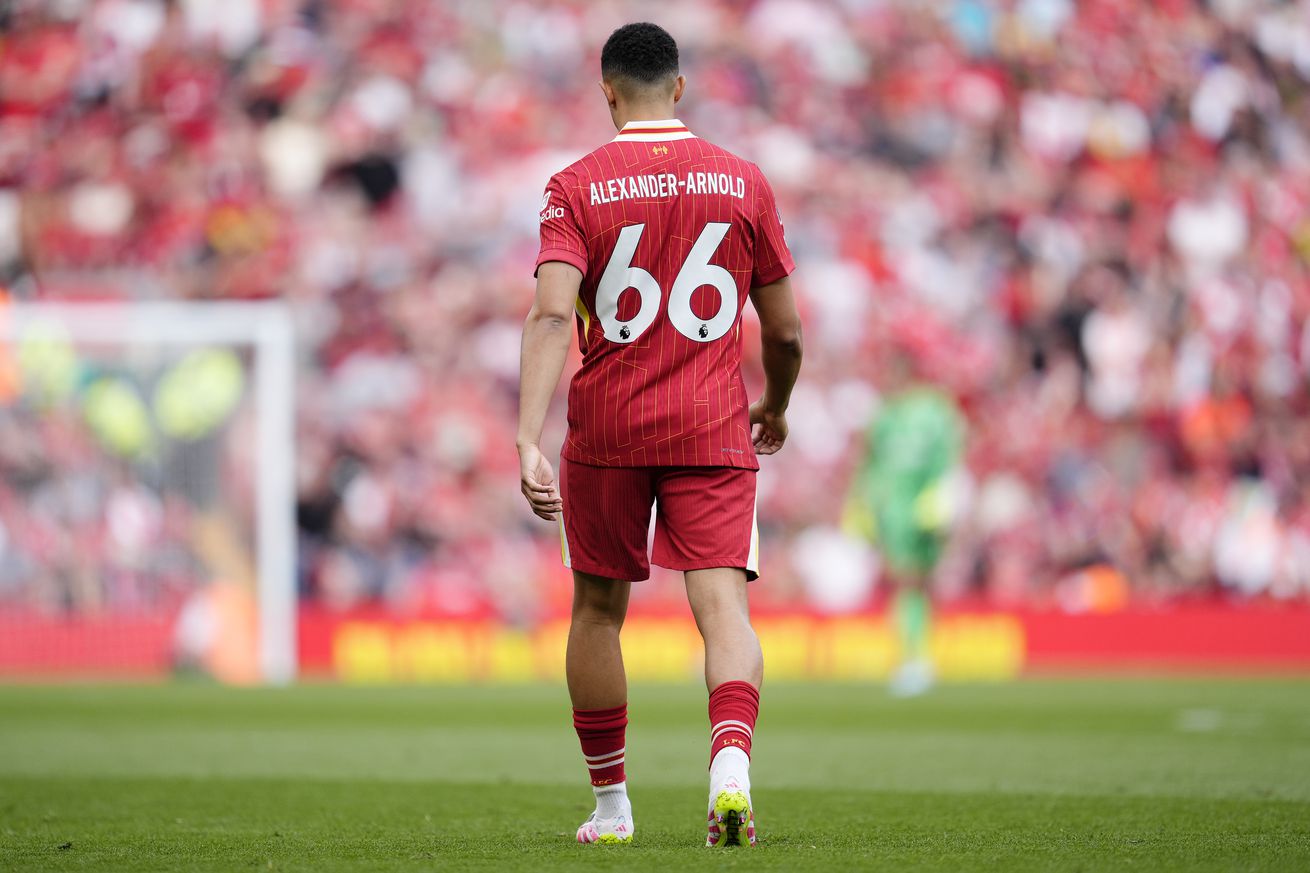
It’s a sad way to sign off with Liverpool but as the player reminded everyone with his West Ham celebration in December this is his life, his choice, and his career.
Liverpool faced Arsenal at home on Sunday having already won the Premier League and with 26-year-old homegrown star right back Trent Alexander-Arnold starting the day on the bench. In part that was because the player had just announced his intention to depart the club on a free and join Real Madrid at the end of the season.
Alexander-Arnold didn’t start in part because there were concerns the supporters might react badly. And when the player came off the bench to warm up ahead of his introduction, there was certainly some grumbling from the crowd that hinted at those concerns being well founded. Which meant it hardly could have been a surprise to anyone that when he did come on his arrival was met with a mixture of cheers and boos. It’s probably fair to say that it was the latter winning out.
To get it out of the way off the top, I didn’t love the booing.
I think if Anfield wanted to make a point, silence when the player came on and then any time he touched the ball would have been preferable. But I also do think there’s a lot whole going on when it comes to Alexander-Arnold’s departure that makes it easy to understand why the matchgoing fans in particular might be in a mood to grumble audibly.
Other Liverpool players have run down their contracts and left, some quite popular ones in recent seasons, even. Agree with it or not, though, the simple reality is that a homegrown player is always going to be held to a higher standard on that front.
So too a player who runs down their contract in their prime years. A fan favourite like Roberto Firmino—to pick a recent free transfer away from the club who was given nothing but love from the fans ahead of his departure—leaving post-prime because he doesn’t see a starting role if he sticks around is naturally going to be seen more kindly.
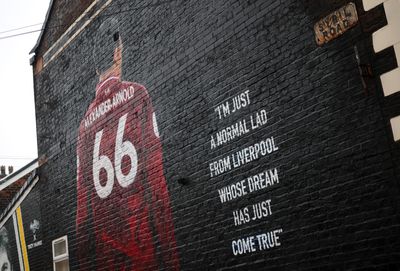
Photo by Carl Recine/Getty Images
One is a player adopted by the city and fans parting ways after having given the club his best. The other is a local lad most saw as a future captain instead leaving on a free to give somebody else his best after previously talking about how winning trophies with Liverpool means more than with other clubs. People are naturally going to be a little more heated and a little less inclined to send the latter off with their blessings, and to pretend otherwise seems a touch obtuse.
There’s also an aspect where, fair or not, it’s perceived Alexander-Arnold went out of his way to set himself up to be able to leave on a free at 26 years of age after signing a four-year extension back in 2021—a year when Alisson Becker, for example, signed a six-year extension with the club.
And there’s the part where it feels a little, due to Alexander-Arnold’s friendship with Madrid midfielder and one-time Liverpool target Jude Bellingham, as if he’s been planning on going to Madrid for some time now. And there’s the part where Madrid have been Liverpool’s chief tormentors in Europe going back through the Jürgen Klopp era.
In England, Liverpool’s dreams of glory have repeatedly been thwarted by Manchester City over the past decade. In Europe, it’s been Madrid.
They’re the side that knocked Klopp and Alexander-Arnold out of Europe on four separate occasions. They’re the side that dislocated Mohamed Salah’s shoulder. They’re the side that concussed Loris Karius. They’re rich, they’re powerful, and they’re petulant. They get all the calls in their favour then complain about not getting enough calls in their favour. They moan and protest when their star—off a worse statistical season than Mohamed Salah—doesn’t win the Ballon D’Or. And now Liverpool’s homegrown star is joining them on a free he appears to have been angling towards for at least a few years.
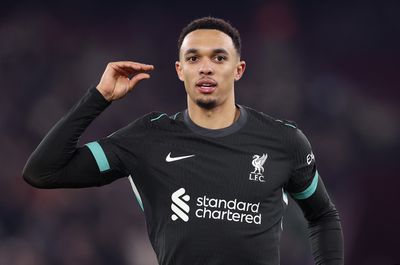
Photo by Julian Finney/Getty Images
Some in the crowd will surely also have been thinking back to when Liverpool faced West Ham just after Christmas and, with rumours about his Madrid move ramping up, Alexander-Arnold celebrated a goal by making a keep talking (or, if you don’t want to be polite, chat shit) hand gesture towards the Travelling Kop. It’s the same celebration Bellingham directed at Dortmund fans he thought should stop speculating about his future—before he did what everyone was talking about him doing and joined Madrid.
I also think all this awkwardness could have easily been avoided by simply not playing Alexander-Arnold. It might be easy to say in retrospect, but his introduction didn’t make Liverpool better—there’s a solid case, in fact, that they looked worse for it. And the game and result didn’t matter outside of pride. Maybe, with two more weeks to let the fans better work through their feelings, Anfield would have been more receptive to a last-day cameo with the Premier League trophy out on the pitch.
Perhaps, if Liverpool had taken a step back this season and clearly entered into a rebuild under Arne Slot in his first year replacing Klopp, fans would have better understood Trent’s desire to try something new. It rather feels, perhaps, as though the player was counting on that being the case. It turns out now that isn’t the case, of course, and so while I didn’t personally love the boos and they might not have been my choice, I do get understand Anfield feeling a little grumpy.
Still, it doesn’t feel at all a fair way to put a bow on the Liverpool career of a player who in every manner but his leaving deserves to be counted as a club legend. I don’t think it’s a fair reflection of Alexander-Arnold’s contributions over the years. But I do think some discontent is understandable.
I think that while I don’t love the boos, I can’t judge the fans—many of whom are the same supporters who have backed him the loudest for years in the face of constant and often unfair criticism and abuse from other fanbases and the pundit class over his perceived defensive shortcomings—for giving in to the urge to level them.
It’s a bit of a shame, perhaps. But then his manner of leaving, running down his deal and departing his boyhood club to join their chief European tormentors on a free as he enters his prime years after ensuring he’d have the freedom to do so by only agreeing a relatively short contract? Well, that’s all a bit of a shame, too.
It’s a sad way to end things, but let’s not pretend now that the person with the greatest degree of control over how it’s ended isn’t Trent Alexander-Arnold himself. As he seemed to be saying to the Travelling Kop back against West Ham in December, this is his life and his career. At the end of the day this is his decision he’s made, too, and when he did he knew—or at least should have known—how it was probably going to go today.